Andrew McClintock: Elliot, the piece that you wrote about taste…the conversation has been going on online now for a year.
Elliot Vredenburg: Our conversation the other day made me think a lot. And I think the point about Walter Benjamin also is really sharp and I think kind of unavoidable. As you said, the original withers inevitably. That part is certainly correct and I think what I was arguing is not that the original survives but that a different kind of role survives — it's the capacity to assign meaning rather than execute craft.
We were talking about this idea of the affect-industrial complex where things that feel good are produced at an industrial scale. I'm reminded of Rem Koolhaas's Junk Space — this aesthetic commons that really conceals its construction. So it does look like infinite possibility but its contamination really… talking about navigation — the map is bad, in other words. So the options aren't necessarily expanding; they're narrowing. You're not really navigating — infinite possibilities — but more so circling a drain.
Nikita Walia: What is so interesting about this Silicon Valley obsession with taste is it assumes that you can scale taste infinitely. And if you look at the luxury industry and the big conglomerates and the condition they're in now…you would see that that's a pretty bad business model that you cannot scale taste or luxury infinitely. What inherently makes it special is that it is limited and artisanal. And if you apply a SaaS approach to taste, I'm not really sure you're doing taste as much as really just mechanical reproduction or readymade of some brand you admire.
Elliot Vredenburg: I mean, as soon as it becomes a discourse, it's kind of being absorbed into the very thing it's trying to resist. So the moment you announce it, then that kind of loses what made it valuable in the first place.
Andrew McClintock: The real tastemakers are completely underground and removed from the system. So therefore, there's maybe no new organic taste getting in.
Elliot Vredenburg: I think it's practiced, this kind of disinterestedness — if you're familiar with the term. Where it's really practiced carelessness or effortlessness — ultimately that's the way that we're functioning now.
Andrew McClintock: Nikita, how does that fit into some of your writing like the TikTok Oracle piece related to the distribution systems of this?
Nikita Walia: I think there's a few things happening. Obviously, in my piece I talked pretty extensively about this very broken labor economy that we have. And so we have a lot of people performing taste or performing intellect etc. that's not really substantiated by actual experience or creating design etc. And this creates this loop of: they know how to speak to the algorithm. Their wrong ideas get amplified and then the actual practitioners of the thing — aren't the ones that people are turning to to get the most salient advice. […]
People need to separate trend from trending as a function of an algorithm and a hashtag on a social platform. A real trend takes so many years to metabolize. And you can apply that to anything as simple as the width of pants to what it's been almost like twelve, fifteen years now where it took things politically in the US to get to the extreme that they are now. It was not an overnight thing.
And that's why I think sometimes people apply the wrong framework when they make these big declarative statements. The other day I joked that something on LinkedIn is always being born or dying and that is truly the best way to get attention now.
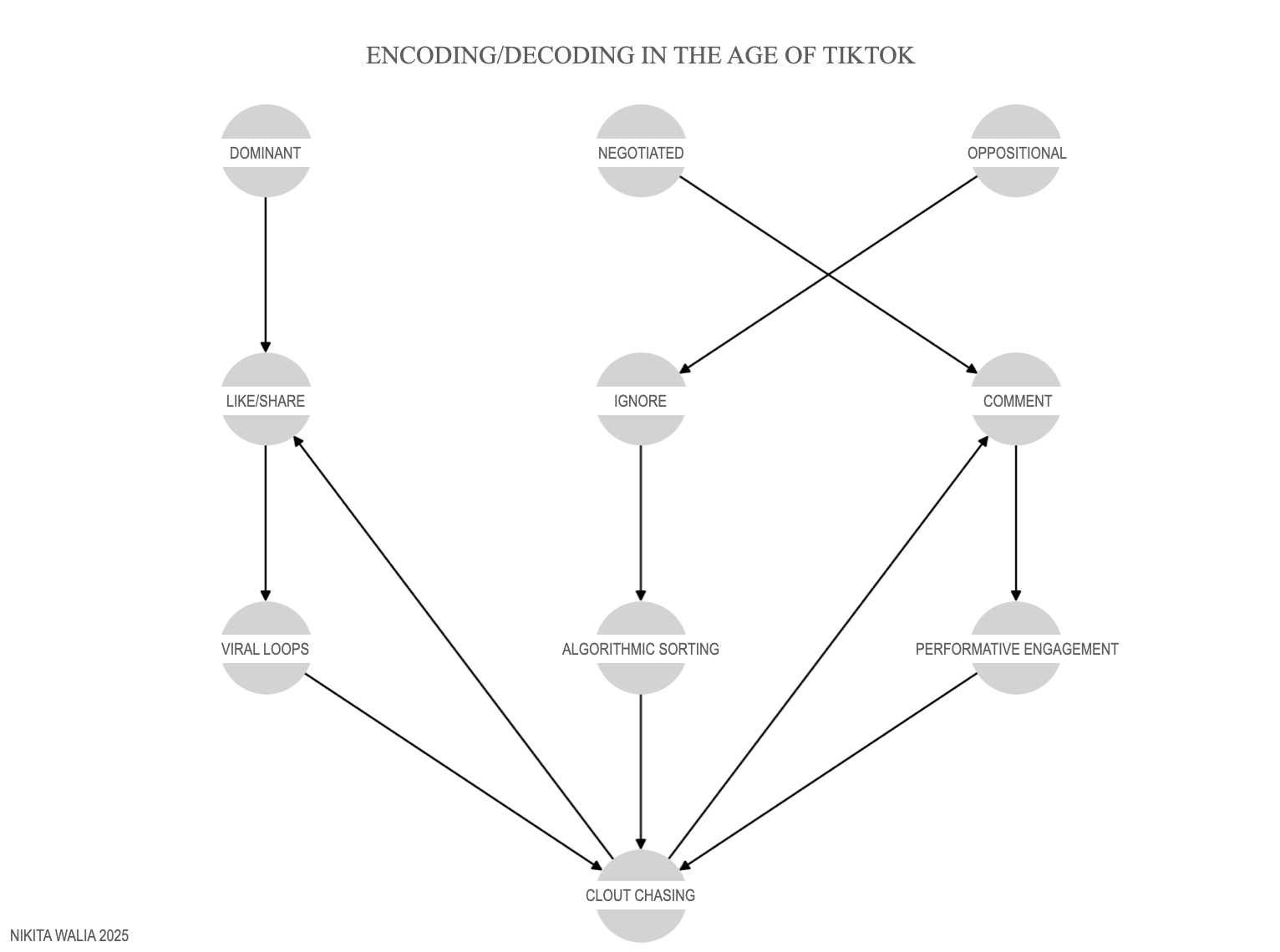
Andrew McClintock: How does creative capital and soft power distribute itself through culture?
Elliot Vredenburg: There's so much to say about soft power and hard power. […] When you think about that in today's environment — hard power is actually the thing that makes soft power visible, and right now hard power isn't as obvious as the infrastructure that lies under it — the industrial complex is really hard power operating in soft power's clothing.
So really it's like, what is machine readable? Ultimately can you operate in a similar way where you're working somewhat obliquely in a register that isn't necessarily at a pace that the algorithm can. In the most literal sense — the most obvious examples are just physical spaces or things that are more related to language or clothing — the sort of things that are all real demonstrations of cultural capital in a Debordian way. Ultimately, taking things back to taste, a disinterested aesthetic position is itself a class position and whenever you "announce it," it then surfaces to that level where it becomes machine readable.
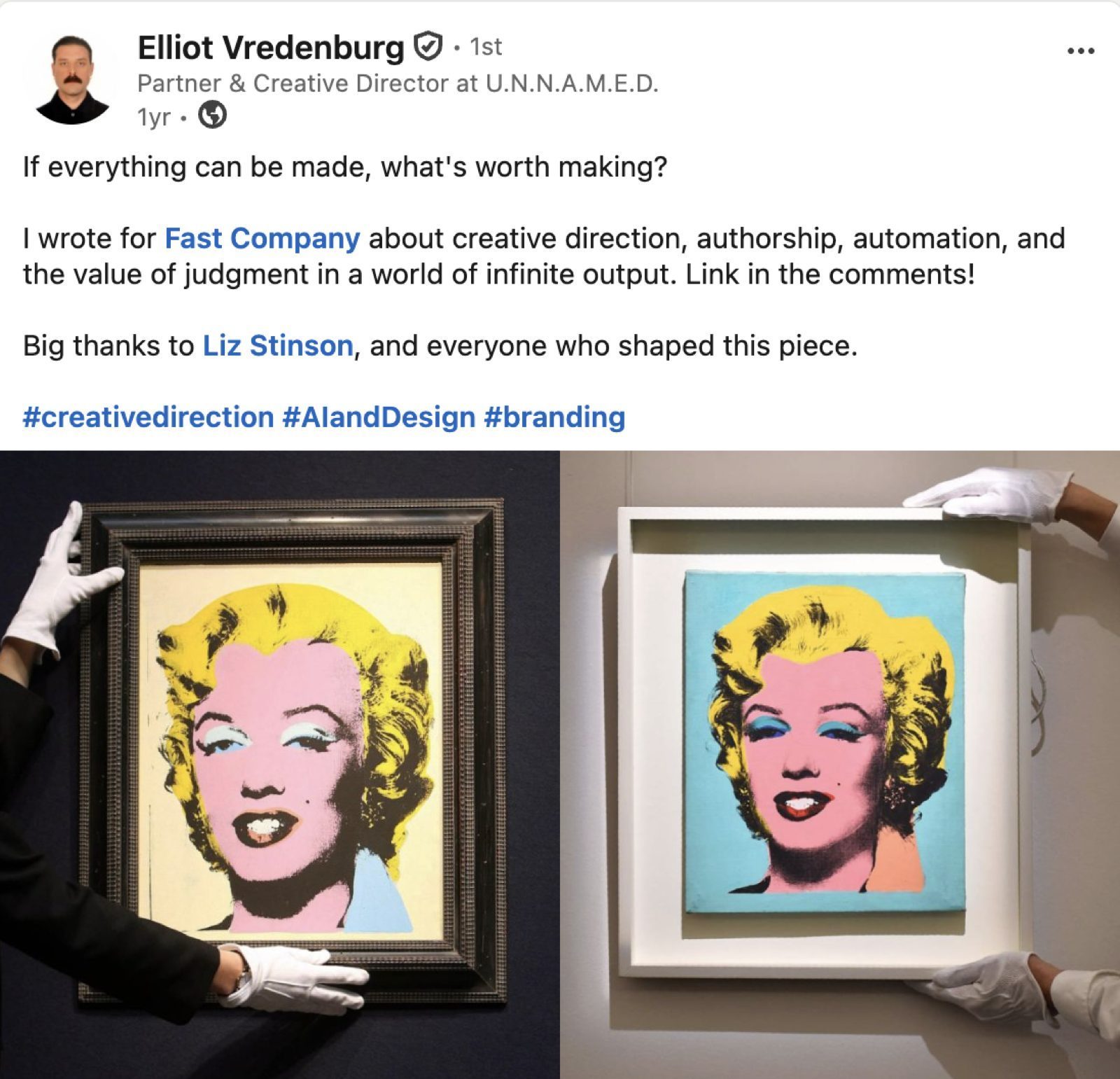
Nikita Walia: I guess something that I also really struggle with is this dominant cultural narrative that things are dead, our culture is stagnant. I think both things are true: that culture is active and also culture is stagnant — and you can find this trend of bipolarity. […] I just have a lot of issues with the way that people in this industry talk about culture as a thing to be managed or exploited or — this is more culturally forward or that. In my approach to culture, regardless of what you're doing, even if your brand is Clorox, you are within a culture because we are living in a culture — an operating system for where we are — the rules we live in and the morals we don't embrace.
Elliot Vredenburg: You could also say it's true of not just culture but society; there is no position outside of the machine at this point — there is no outside to the totality so we're all operating within this contaminated field while still aware of the apparatus that we're operating within.
Andrew McClintock: Let's talk about the piece that you wrote, Nikita: This Is Your Brand with a Universe.
Nikita Walia: The talk that Elliot and I gave [at MoMA] was an evolution of that thinking and it is also the foundation of how we build brands at U.N.N.A.M.E.D. — of what the fixed nucleus is of cultural impact and message that we want to convey and keeping that as a fixed set of elements — as a look, a style, a way of communicating.
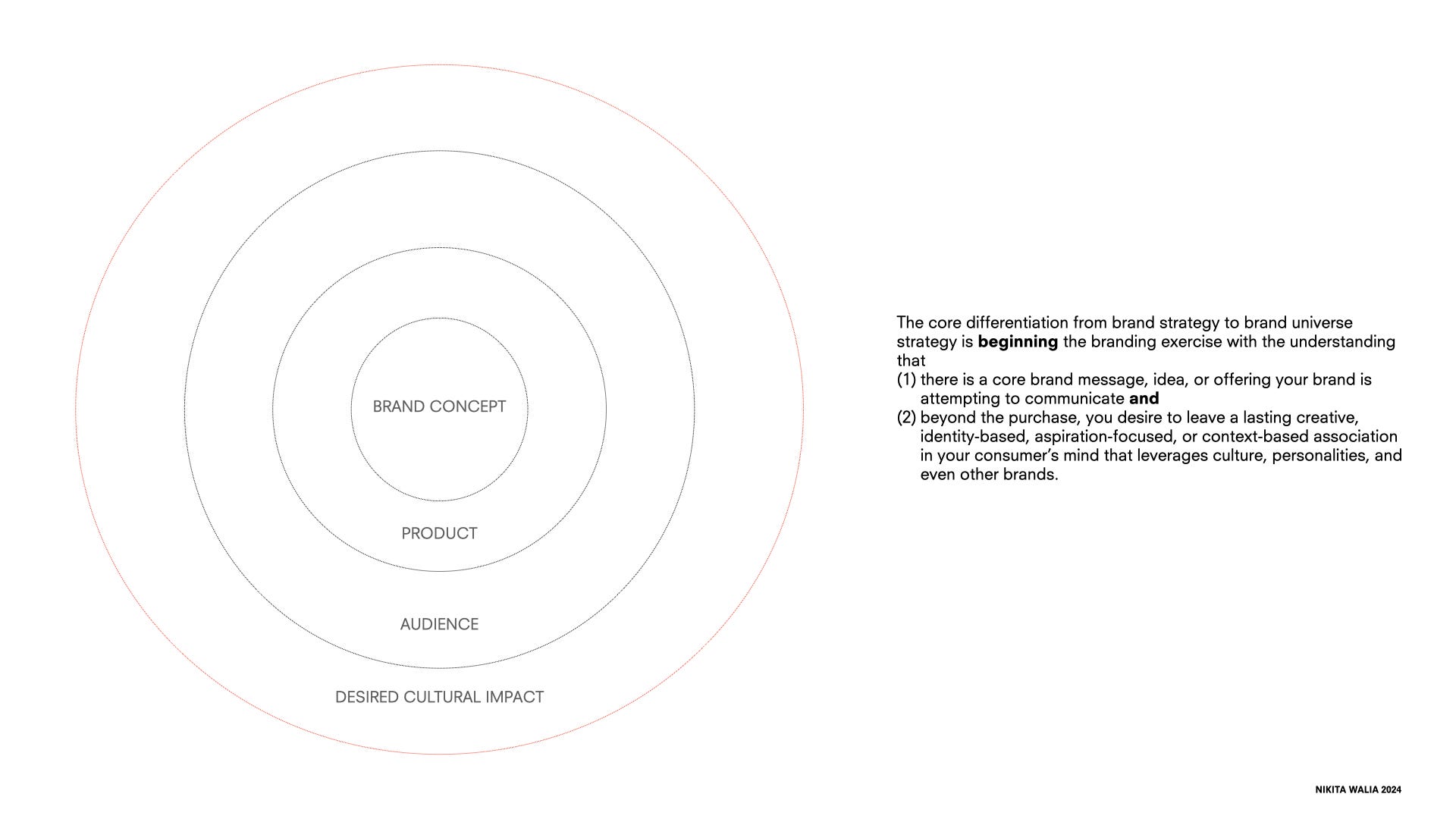
Then being able to bend into culture and different demographics. I think you cited my Loewe example in that piece — that was a dusty Spanish leather brand but they hired a creative director with the right aura. They hired a creative team around him that was making images that quite literally referenced the legacy, present, future of Loewe in every piece of print advertising they did. And I think they were truthfully forward-looking enough to see that there's fixed points where they show up on something like Instagram is very manicured and beautiful, similar to how they show up in print, but then to expand the halo of this brand and one day maybe there's a Gen Z on TikTok that'll think fondly of Loewe and go buy their first fancy bag at Loewe when they get a big girl job instead of Chanel by leaning into the culture and the current of the platform. But it all felt Loewe.
Elliot Vredenburg: Loewe is a great case study because it shows that coherence doesn't mean consistency. As Nikita is saying, you have this nucleus which is Jonathan Anderson's cultural capital that is the orienting force — that becomes the compass. Everything can then vary based on the platform, based on context. So, it's about creating a cultural infrastructure at the brand level rather than having a box that you have to stay within. Because I think most organizations without that kind of orienting force — that same thing would produce incoherence… so that's the model.